netscan
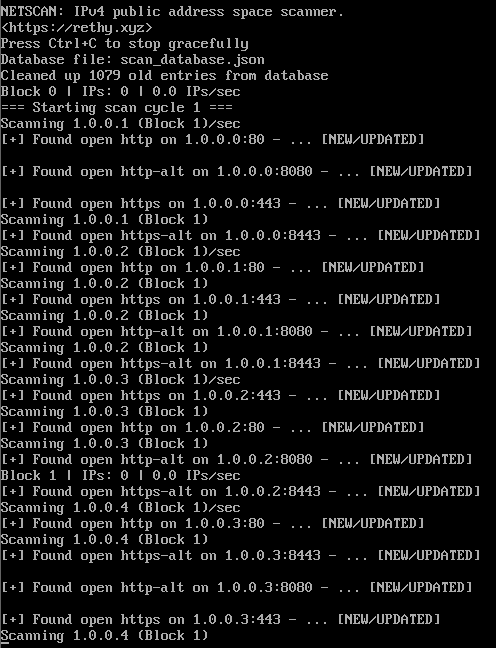
IPv4 public address space scanner.
Overview
- JSON database
- New/old information is modified according to current date.
- Old information is removed after 30 days (default value)
- Supports banner and protocol version detection
Environment Information
Can be run on Windows or Linux. Optimally, install it on Linux.
Install with a VPN, and preferably headless, on a locked down system.
Files Included
netscan.py
The core of the netscan program. Scans all public IPv4 internet addresses in order from lowest to highest, looking for commonly exploitable ports. If found, they are logged in a JSON database for further action.
In the case of netscan, it is just a scanner, not an autonomous scanner + exploitation system. The idea is netscan scans, and you can do whatever you want with the information afterwards.
One supplicant script is provided to demonstrate one of the most common exploits for an out-of-date SSH version, ssh-2.0-exploit.py.
scan_database.json
scan_database.json is the core database read from, updated, and maintained by the netscan.py file. Entries contain an IP, when an online host was first seen on that IP, last updated, and opened ports (ports-to-check are defined through a global variable array within netscan.py)
scan_database.json isn't provided, but generated on program run. The general format will look like the following:
{
"1.0.4.18": {
"first_seen": "2025-07-23T22:59:36.043442",
"last_updated": "2025-07-24T09:25:11.530446",
"ports": {
	"22/ssh": {
	"status": "open",
	"banner": "SSH-2.0-OpenSSH_9.6p1 Ubuntu-3ubuntu13.11",
	"last_seen": "2025-07-23T22:59:36.043442"
	},
	"443/https": {
	"status": "open",
	"banner": "",
	"last_seen": "2025-07-24T09:25:11.526049"
	},
	"80/http": {
	"status": "open",
	"banner": "",
	"last_seen": "2025-07-24T09:25:11.530446"
	}
}
},
"1.0.16.9": {
"first_seen": "2025-07-23T23:25:14.983380",
"last_updated": "2025-07-23T23:25:14.983380",
"ports": {
	"22/ssh": {
	"status": "open",
	"banner": "SSH-1.99-Cisco-1.25",
	"last_seen": "2025-07-23T23:25:14.983380"
	}
}
},
...
ssh-2.0-exploit.py
Running python3 ssh-2.0-exploit.py $IP_ADDRESS (default port 22) on an SSH host running some derivative of SSH version 2.0 will attempt an RegreSSHion brute force attack (CVE-2024-6387).
The attack works as follows (explanation taken from https://www.varonis.com/blog/openssh-regresshion-rce-vulnerability):
- Establish an SSH connection to the target server
- Perform the initial handshake
- Use heap spraying to send a sequence of packets that manipulate the server's memory allocation patterns
- Measure the server response time to fine-tune the exploit timing
- Send a carefully timed packet to exploit the signal handler race condition
- Once successfully exploited, deliver a shellcode payload for privileged execution
In this case, as it's only a proof of concept to see how it's done, and as it's primitive, we're only doing step 1, 2, 3, and 5.
